
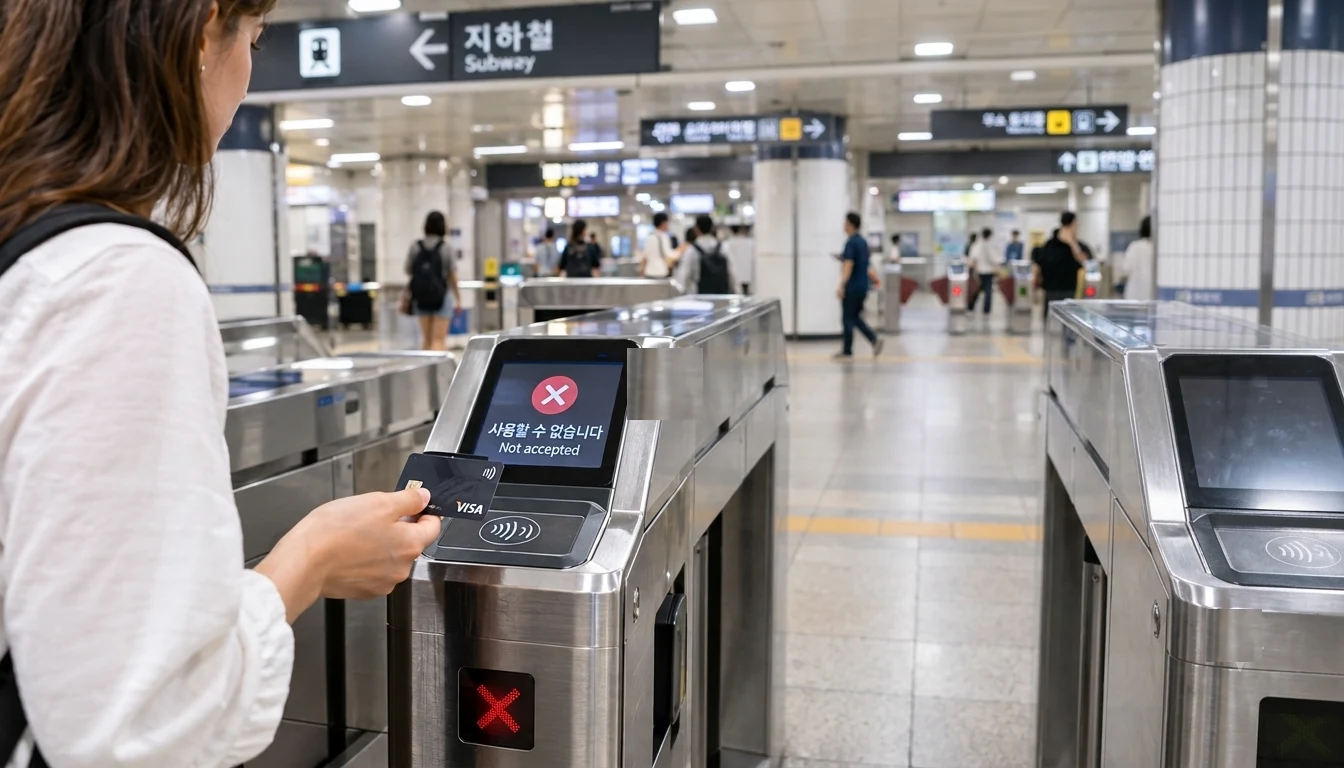
Your foreign credit card already works at most convenience stores, cafes, and department stores in Seoul.
The subway turnstile and the bus card reader are two of the last places it doesn’t.
That’s changing, just not as fast as the headlines make it sound.
Will Your Foreign Credit Card Work on Seoul’s Subway and Buses?
Not yet. As of today, Seoul’s subway gates and bus readers only accept T-money: either a physical card, a T-money-enabled phone, or a rechargeable card like WOWPASS built on the same T-money network. A foreign Visa, Mastercard, UnionPay, or JCB card tapped directly on a turnstile will not work.
That’s the part changing. On September 17, 2026, T-money signed a memorandum of understanding with Visa, Mastercard, UnionPay, JCB, and Hana Card to build what’s called EMV open-loop payment for Korean public transit. Once it’s live, a foreign-issued contactless card will be able to tap directly on a subway gate or bus reader, with no T-money card, no top-up, and no separate app.
Visa and Mastercard each also announced their own separate partnerships with T-money within days of the main agreement, aimed specifically at Seoul and Incheon transit. The direction is clear. The timing is the part worth being careful about.
What Is EMV Open-Loop Payment, and How Is It Different From T-money?
EMV open-loop payment means your existing bank card is the transit card. There’s no separate card to buy, load, or refund at the end of your trip.
T-money, by contrast, is a closed-loop system: a prepaid card or app balance that only works within Korea’s transit network, funded either with cash, a Korean bank account, or (already, today) an international card used to top it up. It works well, but it’s still an extra card in your wallet.
EMV: the standard behind your everyday tap-to-pay
EMV stands for Europay, Mastercard, and Visa, the alliance that created the global chip-and-contactless payment standard. It’s the same technology behind tapping your card on a coffee shop reader, and open-loop transit systems just extend that to a subway gate. London (2012), New York, Hong Kong, and Singapore all run on versions of it already.
The trade-off is one Korea-specific feature: T-money’s transfer discount. Because open-loop systems bill your card directly per tap rather than tracking a single prepaid balance across a trip, most cities that have adopted it, including Japan’s (more on that below), don’t apply the free-transfer discount T-money gives you between a bus and a subway ride within the window. Whether Seoul’s system preserves that discount hasn’t been confirmed yet.
When Is This Actually Launching?
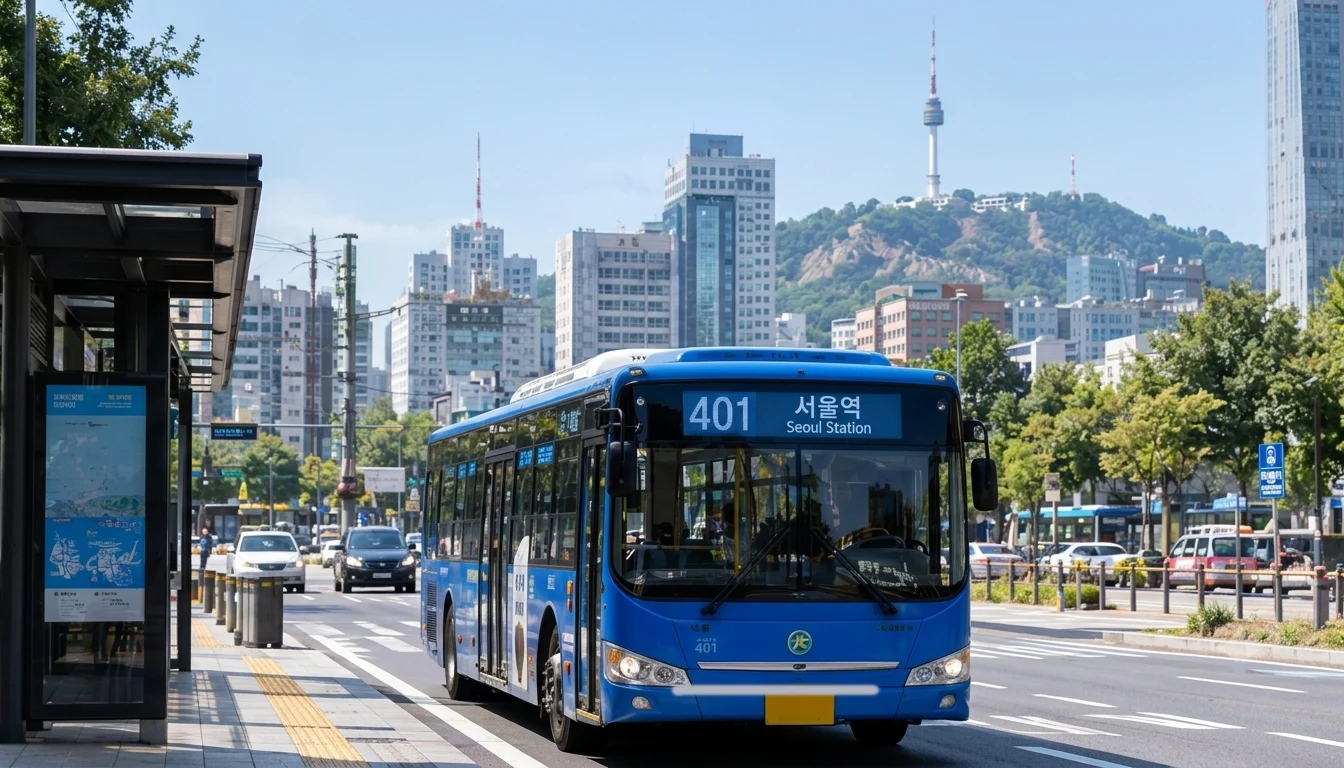
T-money’s own timeline: system development and integration testing through the end of 2026, with a phased rollout starting on Seoul city buses in 2027, then expanding to Incheon buses and airport buses. Separately, Seoul city has stated a goal of full EMV open-loop coverage by 2030, spanning buses, subway, mabeul (village) buses, private railways, and every regional transfer system.
Neither date is close. If your trip is in the next year or two, plan around T-money as it exists today, not around a rollout that’s still in the testing phase. We’ll update this guide as soon as Seoul buses actually go live.
Not new, just new to Korea
Japan rolled this out to real scale already: 11 railway operators across the Kanto region switched on EMV open-loop simultaneously in March 2026, and more than 220 transit operators across 45 prefectures now support it. If you’ve tapped a foreign card on a Tokyo ticket gate recently, this is the same idea arriving in Seoul.
What Should You Use for Seoul Transit Right Now?
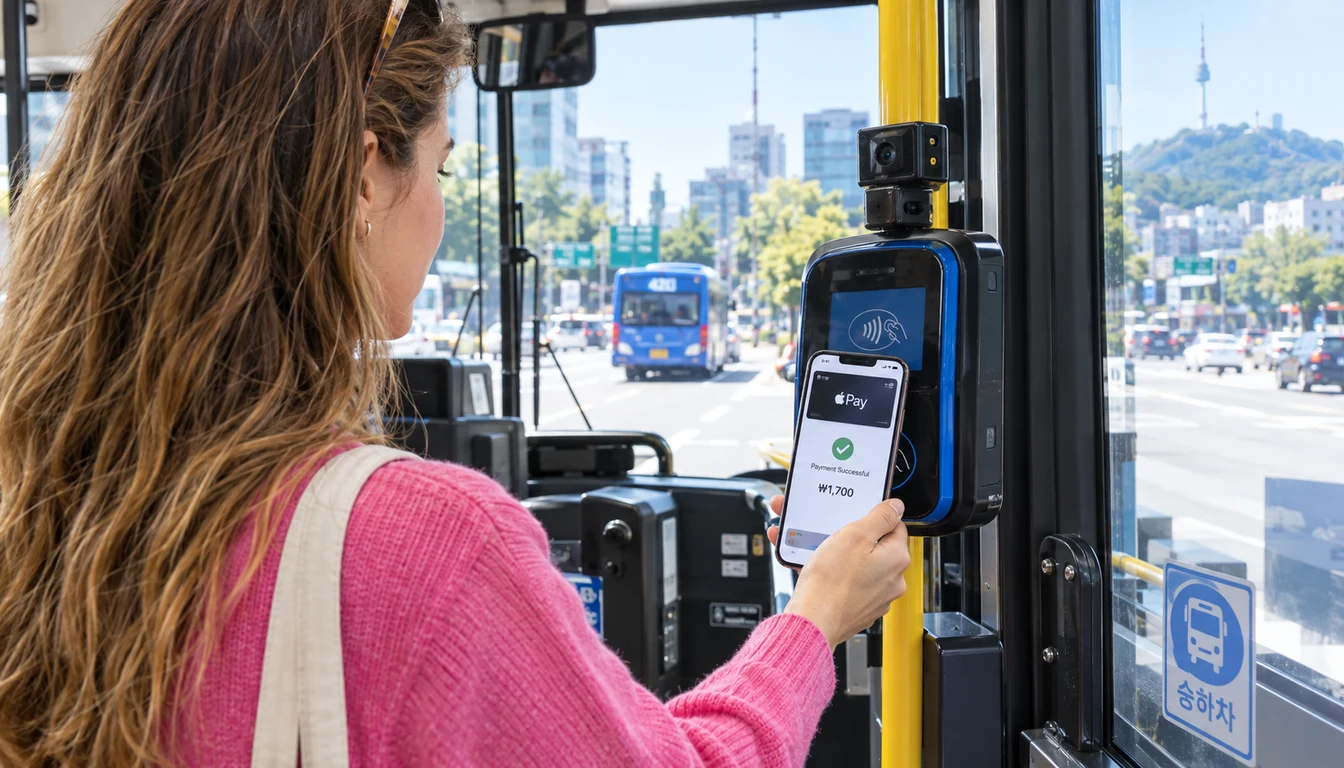
Mobile T-money on your phone is the simplest option, since it already accepts international card top-ups, so you skip the convenience-store line entirely. A physical T-money card, sold at any convenience store and most subway stations, works identically if you’d rather not rely on your phone battery.
WOWPASS is worth knowing about too: it’s a prepaid card built specifically for visitors that doubles as a T-money-network transit card and a general debit-style card, loaded with foreign cash or a foreign card at kiosks around Seoul. See our Korea travel apps guide for how Mobile T-money, WOWPASS, and the rest fit together, and our currency exchange guide for a broader look at paying for things in Korea generally.
Heading to Busan instead of, or in addition to, Seoul? A different and already-live system there lets you pay bus fare straight from apps like Alipay or WeChat Pay. See our Busan bus QR payment guide for how that one actually works today.
Seoul Tap-to-Pay: Quick Answers
No. Seoul’s subway gates and bus readers currently only accept T-money: a physical card, a T-money-enabled phone, or a T-money-network card like WOWPASS. EMV open-loop support for foreign cards is announced but not live yet.
T-money plans to finish system development and testing by the end of 2026, with Seoul buses first in 2027, followed by Incheon and airport buses. Seoul city has separately set a goal of full coverage, including subway, by 2030.
Visa, Mastercard, UnionPay, and JCB have all signed on through T-money’s September 2026 agreement, with Hana Card handling domestic settlement. Visa and Mastercard also announced separate, more specific partnerships with T-money targeting Seoul and Incheon.
Not confirmed yet. Most open-loop systems elsewhere bill each tap directly rather than tracking a trip balance, which typically means no free-transfer discount between bus and subway. Seoul hasn’t announced how it will handle this.
Mobile T-money (accepts international card top-ups already) or a physical T-money card, both sold at convenience stores and subway stations. WOWPASS is a solid alternative if you’d rather have one prepaid card that also works for everyday purchases.
We’ll update this guide when the rollout actually reaches Seoul buses, not when the next press release lands.
Until then, the Korea Travel Hotline takes transit questions 24/7 on 1330, and the Foreigners’ General Information Center is on 1345.



Comments
Leave a comment