
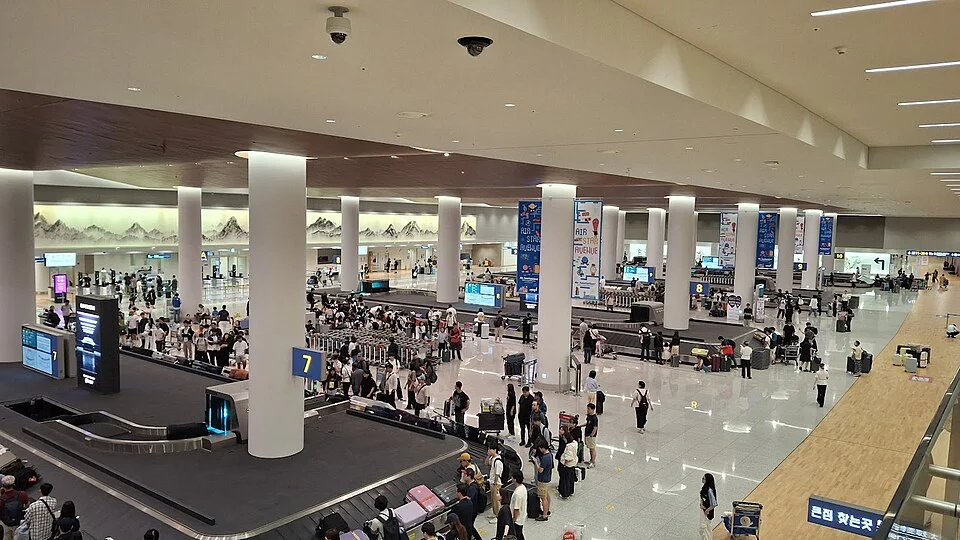
Source: AirportTerminalGuy, Wikimedia Commons (CC BY 4.0)
- How Much Cash Can You Bring Into Korea Without Declaring It?
- What Counts as Cash Under Korea’s $10,000 Rule?
- How Do You Declare Cash When Entering Korea?
- How Much Cash Can You Take Out of Korea Without Declaring It?
- What Happens If You Don’t Declare Cash Over the Limit?
- Is There a Maximum Amount of Cash You’re Allowed to Carry?
- What Are Some Practical Tips for Carrying Large Amounts of Cash in Korea?
- Cash Declaration Questions, Answered
Packing extra cash before a Korea trip feels like a smart hedge, until you remember there’s a reporting rule tied to how much you’re carrying.
Go over US $10,000 without declaring it, and what should’ve been a 30-second form turns into a conversation with a Customs officer, or a real penalty.
Here’s the exact threshold, what counts toward it on the way in and the way out, and how to handle the paperwork in under a minute.
How Much Cash Can You Bring Into Korea Without Declaring It?
You can bring any amount of cash into Korea. The US $10,000 figure isn’t a cap, it’s a reporting threshold: carry foreign currency, Korean won notes, or cashier’s checks that add up to $10,000 or less combined, in any mix of currencies, and you walk through Customs without filling out a single extra form. Go over that amount, whether it’s one stack of dollars or several currencies that add up past the line, and Korea’s Foreign Exchange Transactions Act requires reporting it to Customs on arrival. The threshold applies per person, not per family traveling together, so two travelers each carrying $8,000 don’t need to declare anything, while one person carrying $12,000 alone does. None of this is about taxing your money or holding it at the airport. Declaring correctly costs nothing and takes a couple of minutes at the Customs counter, well before baggage claim or the taxi stand.
Still deciding how much money to bring in the first place? Our Korea trip budget guide breaks down typical daily costs by travel style, which is usually a more useful starting point than packing a flat five-figure sum “just in case.”
This currency rule is one small piece of a bigger arrival process. If you haven’t worked through the rest of it yet, our immigration and customs guide covers the arrival card, duty-free limits, and Q-Code in full.
What Counts as Cash Under Korea’s $10,000 Rule?
Korea’s declaration threshold isn’t limited to paper bills folded into your wallet. The Korea Customs Service defines the reportable category as “means of payment,” which explicitly includes foreign currency cash, Korean won notes, and cashier’s checks, all added together regardless of which currency they’re in. Traveler’s checks and similar negotiable instruments are generally treated the same way, since they function as a direct stand-in for cash. What’s explicitly excluded is more specific: promissory notes, letters of credit, and bills of exchange don’t need to be reported or authorized on arrival at all, regardless of their face value, since they aren’t treated as liquid cash under this rule. Payment cards and electronic transfers fall outside the rule entirely too, since nothing physical crosses the border with them. Carrying a prepaid card loaded with $15,000 isn’t a declaration issue. Carrying $15,000 in bills is.
- Foreign currency cash, in any combination of currencies
- Korean won (KRW) cash
- Cashier’s checks, including those denominated in Korean won
- Traveler’s checks and similar negotiable instruments (generally treated the same way)
What Doesn’t Count Toward the Threshold
- Promissory notes, letters of credit, and bills of exchange (exempt from reporting on arrival)
- Balances on debit, credit, or prepaid cards
- Bank wire transfers
How Do You Declare Cash When Entering Korea?
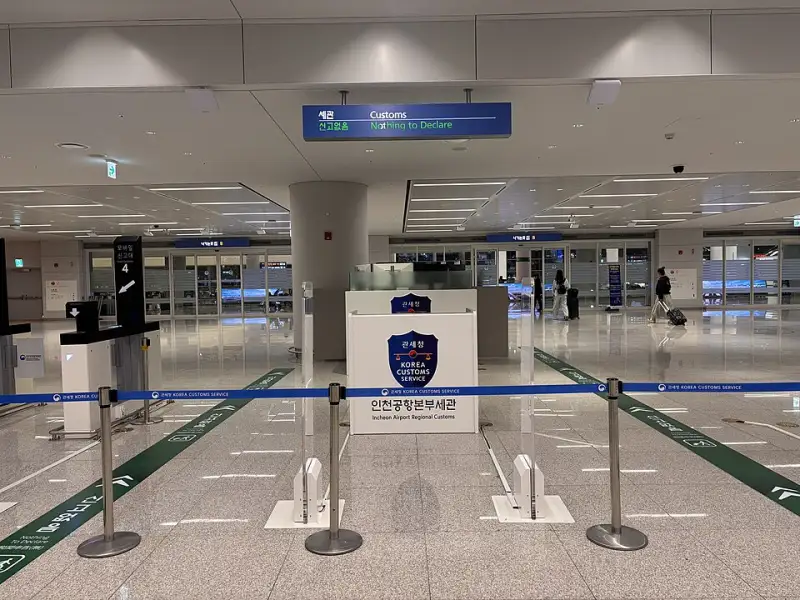
Declaring cash when you land in Korea is one step, done at the Customs counter before you leave the arrivals area. Korea’s Traveler Declaration Form, separate from the e-Arrival Card you may have already submitted for immigration, has a line asking whether you’re carrying means of payment over US $10,000. Mark yes, write the specific amount, and hand the form to the Customs official at the red “Goods to Declare” channel. In exchange, you receive a Certificate of Foreign Currency Declaration, proof that the cash was declared rather than carried in quietly. That certificate matters more than it looks: it’s the simplest way to show, if you’re ever asked later, that the money was declared legitimately. One detail worth remembering, the certificate can’t be issued once you’ve left the immigration and Customs area, so this isn’t something to sort out after picking up a rental car or checking into a hotel.
- Fill out Korea’s e-Arrival Card before or during your flight (this covers immigration, not the currency declaration itself).
- At the Customs counter, mark yes on the currency declaration line of the Traveler Declaration Form and write the exact amount you’re carrying.
- Go through the red “Goods to Declare” channel instead of the green line.
- Hand your form to the Customs official and show the cash or checks if asked.
- Collect your Certificate of Foreign Currency Declaration before leaving the arrivals area, and keep it with your passport for the rest of the trip.
Keep the certificate
If you plan to leave Korea with close to what you declared coming in, your Certificate of Foreign Currency Declaration is the easiest way to prove it on departure, so keep it with your passport rather than setting it aside after arrival.
How Much Cash Can You Take Out of Korea Without Declaring It?
The same US $10,000 threshold applies on departure, but the paperwork branches depending on whether you’re a resident or a short-term visitor. For most tourists, the common case is simple: leaving with less than $10,000, or with no more than what you originally declared bringing in, requires no new report. Korean residents face an extra layer. Carrying more than $10,000 for general travel expenses means reporting it to the head of the relevant Customs office before departure, while larger amounts tied to relocating abroad, studying overseas, or living abroad long-term require advance confirmation from a foreign exchange bank instead of a Customs-counter report. Both sides of this rule sit under the same Foreign Exchange Transactions Act as the arrival-side declaration, and Korea’s government treats entry and departure as one continuous cash-courier reporting system rather than two unrelated rules.
| Situation | Korean residents | Non-residents (most tourists) |
|---|---|---|
| Total of $10,000 or less | No report | No report |
| Over $10,000, general travel expenses | Report to the competent Customs office | No general self-report option; see bank confirmation routes |
| Over $10,000, relocation / study abroad / long-term residence | Confirmation from a foreign exchange bank required | Not applicable |
| Taking out no more than what you declared at arrival | Separate report required for use | No new report; keep your arrival certificate as proof |
| Other funds (property sales, securities, deposits, re-exchanged casino winnings) | Reported through the relevant channel, separate from Customs | Certificate of declaration required |

For the vast majority of visitors, this comes down to one of two cases: you’re leaving with less money than you arrived with, or you’re leaving with about the same amount you declared on the way in. Either way, there’s nothing extra to file. If your situation is different, long-term residence, work income earned in Korea, or cashing out casino winnings, check with Korea Customs Service or your bank before your flight, since the paperwork for those cases runs through a bank confirmation rather than a Customs form.
What Happens If You Don’t Declare Cash Over the Limit?
Skipping the declaration isn’t a paperwork technicality Korea treats lightly. Under the Foreign Exchange Transactions Act, exporting or importing means of payment, including cash, without filing the required report can mean imprisonment with labor for up to one year, or a fine of up to 100 million Korean won. If three times the value of the undeclared cash works out higher than that cap, the fine can scale up to three times the cash’s value instead. Korea’s Customs Service frames the entire reporting system around tracking drug money and money laundering, not around collecting extra fees from travelers, which is part of why skipping this one form carries a heavier penalty than, say, forgetting to declare an extra bottle of duty-free whiskey. Declaring cash costs nothing and takes a few minutes. Getting caught without having declared it turns a routine form into a legal problem.
Declare it. Don’t risk it.
Getting stopped with undeclared cash over $10,000 isn’t treated as a minor customs slip. Expect questioning, possible holding of the cash pending investigation, and the criminal penalties above, all for skipping a form that takes less time than claiming your luggage.
Is There a Maximum Amount of Cash You’re Allowed to Carry?
No. Korea doesn’t cap how much cash you can physically carry into or out of the country, and the $10,000 rule doesn’t stop anyone from traveling with more. It only determines whether you need to fill out a form first. Travelers sometimes assume amounts above the threshold are automatically illegal, confiscated on sight, or need special government permission arranged in advance, none of which is accurate for ordinary travel cash. Declare it honestly, collect your Certificate of Foreign Currency Declaration on the way in, and there’s no upper limit on what you can bring as long as its origin is legitimate. Where things genuinely do get restricted is elsewhere: large unexplained cash tied to suspected money laundering or crime still draws scrutiny regardless of declaration status, and Korean residents moving very large sums abroad for things like property purchases or investments fall under separate capital-transaction reporting rules, not the traveler cash-declaration process covered here.
The rule is about reporting, not permission
Nothing in Korea’s currency rule requires pre-approval to travel with large sums. The only action required is an honest declaration at the point you cross the threshold, on arrival or departure.
If carrying that much cash in the first place sounds like more hassle than it’s worth, our currency exchange and payment guide covers ATM withdrawals, prepaid cards like WOWPASS, and how far a card alone gets you in Korea, so you don’t need to carry five figures in bills to avoid running short.
What Are Some Practical Tips for Carrying Large Amounts of Cash in Korea?
A little preparation turns the $10,000 rule from a source of stress into a two-minute formality. Travelers who get flagged for extra questioning are usually the ones who didn’t expect the form to exist, not the ones carrying large amounts honestly. Know the threshold before you land, keep your cash and any supporting paperwork, such as a bank withdrawal slip showing where a large sum came from, easy to produce, and budget a few extra minutes at Customs if you’re near or over the line. None of this changes your trip, it just means the declaration step goes the way it’s designed to, quickly, and without a side conversation with an officer.
- Count your total cash and monetary instruments across every currency you’re carrying, not just the obvious stack of bills.
- If you’re near $10,000, round your estimate up rather than down. Declaring $9,800 as $10,200 by mistake is a non-issue; declaring $10,200 as $9,800 is the one that causes problems.
- Carry basic proof of where large cash came from, such as a bank withdrawal receipt, in case you’re asked.
- Keep your Certificate of Foreign Currency Declaration with your passport for the whole trip if you’re carrying cash close to the threshold both ways.
Useful Official Websites
Cash Declaration Questions, Answered
Only if your total across all currencies and monetary instruments, cash, Korean won notes, and cashier’s or traveler’s checks, comes to more than US $10,000. Below that, no declaration is needed.
You risk imprisonment with labor for up to one year, or a fine of up to 100 million Korean won (more if three times the undeclared amount exceeds that figure). Declaring it voluntarily takes a couple of minutes and avoids all of this.
No. The rule covers physical means of payment: cash, Korean won notes, and cashier’s or traveler’s checks. Card balances and bank transfers aren’t counted, since nothing physical is crossing the border.
Yes. There’s no cap on how much cash you can carry, only a requirement to declare it once you cross $10,000. Declare it honestly and there’s no issue with the amount itself.
Generally no, as long as you’re taking out no more than what you declared coming in. Keep your Certificate of Foreign Currency Declaration as proof in case you’re asked.
Per person. Two travelers each carrying $9,000 don’t need to declare anything; one person carrying $11,000 alone does, regardless of how much the rest of the family is carrying.
At the Customs counter, through the red “Goods to Declare” channel, using the currency declaration line on the Traveler Declaration Form, separate from the e-Arrival Card used for immigration.
Not quite. Long-term relocation, study abroad, and overseas residence expenses above $10,000 go through confirmation from a foreign exchange bank rather than a same-day Customs report, so sort that out before you travel rather than at the airport.
Wondering about the rest of Korea’s entry requirements before this even comes up? Our visa and K-ETA guide covers what to sort out before you fly.
Want to carry less cash in the first place? Our currency exchange and payment guide covers ATMs, cards, and WOWPASS.
Still have questions specific to your situation? Contact the Foreigners’ General Information Center at 1345 (Weekdays 09:00-22:00), or reach Korea Customs Service directly through their Q&A page.
Safe travels, and may your only line at the airport be the green one.



Comments
Leave a comment