
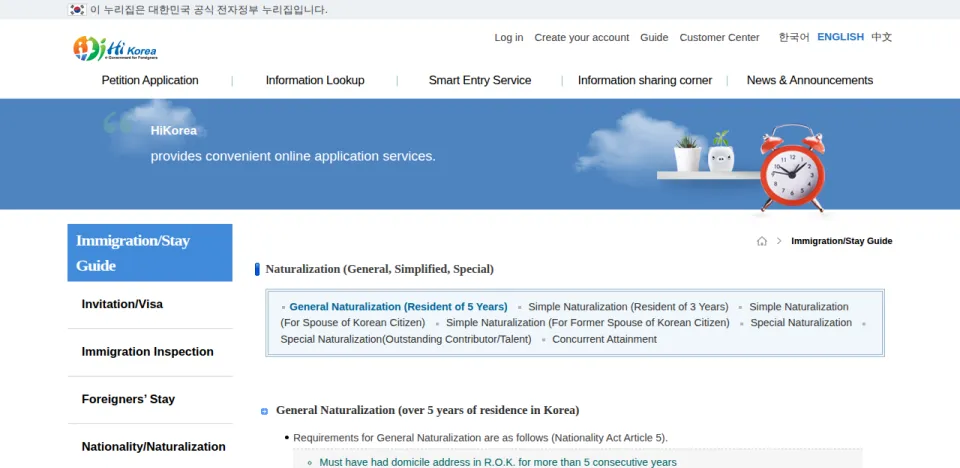
Screenshot: HiKorea official portal, Naturalization types page (hikorea.go.kr)
- What Is the Social Integration Program Comprehensive Evaluation?
- What Does the Evaluation Actually Test?
- How Many Points Do You Need to Pass, and How Much Time Do You Have?
- Who Is Exempt From Taking the Evaluation?
- Need Help With Your Naturalization Application?
- FAQ: Naturalization Interview and SIP Evaluation Questions Answered
Applying for Korean citizenship involves more than paperwork.
Since March 2018, most naturalization applicants also need to pass a Social Integration Program evaluation on Korean language and society.
Here’s how the test works, who’s exempt, and how much time you actually have to complete it.
What Is the Social Integration Program Comprehensive Evaluation?
The Social Integration Program (SIP) Comprehensive Evaluation is the test that replaced Korea’s old written naturalization exam on March 1, 2018. It’s administered through HiKorea, the Ministry of Justice’s official portal for immigration and nationality services, and it checks two things: your Korean language ability and your understanding of Korean society, which HiKorea describes more broadly as general civic literacy. The evaluation is scored on a 100-point scale, and you need 60 points or more to pass. If this is one step in a naturalization application you’re preparing, it helps to know upfront that it isn’t a same-day formality. You’re given a full year from your application date to complete it, which this guide covers in detail further down. Naturalization applications themselves are filed at one of 19 dedicated nationality service offices assigned by your residence jurisdiction, and the evaluation fits into that same process as the language-and-society check HiKorea requires before approval.
Where do I start a naturalization application?
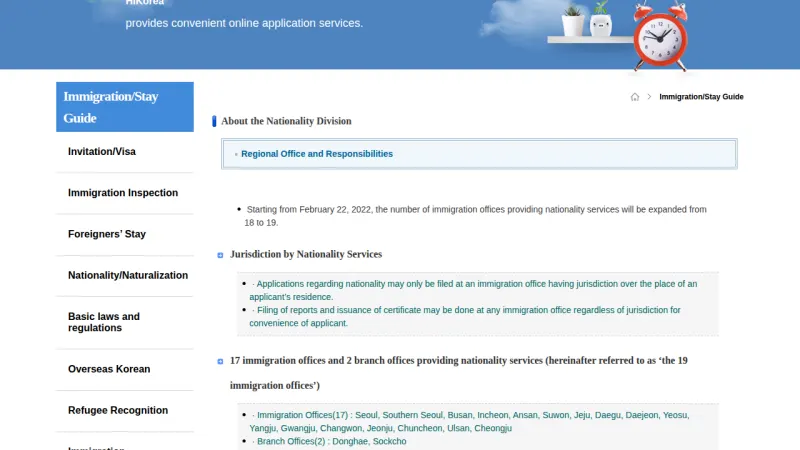
Applications go to one of 19 dedicated nationality service offices, based on your residence jurisdiction (joint applicants use the primary applicant’s address). See HiKorea’s Nationality / Naturalization guide to find your assigned office.
What Does the Evaluation Actually Test?
The evaluation covers two areas: Korean language ability and an understanding of Korean society, which HiKorea frames as comprehensive basic literacy about how the country works rather than a narrow citizenship trivia quiz. This is the same general subject area the previous written test covered before 2018, just delivered in a different evaluation format. HiKorea’s public page doesn’t break down exactly which topics appear or in what proportion, so if you want to prepare systematically, the Social Integration Program’s own coursework (KIIP) is the most direct path, since the evaluation is designed to sit on top of that same curriculum. In practice, this means consistent KIIP attendance doubles as interview preparation rather than being a separate track you’d need to study for from scratch. Think of it less as a standalone exam to cram for and more as a checkpoint that confirms what you’ve already been building through everyday life and KIIP classes in Korea.
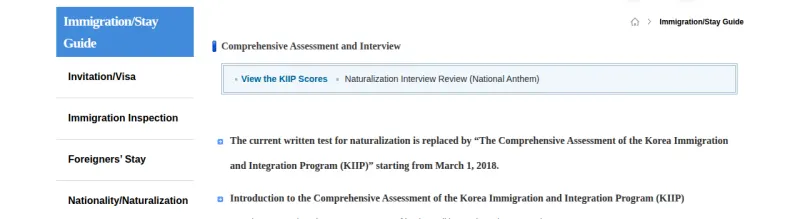
- Korean language ability: likely reading and basic communication skills, though HiKorea’s public page doesn’t itemize the exact skills tested
- Understanding of Korean society: described as general civic literacy rather than a published trivia list
- Exact question format and topic breakdown aren’t published on HiKorea’s page. Your local nationality office can confirm specifics if you want to prepare precisely
How Many Points Do You Need to Pass, and How Much Time Do You Have?
You need a score of 60 or higher out of 100 to pass the Social Integration Program Comprehensive Evaluation. That threshold applies uniformly. HiKorea’s page doesn’t list a separate passing bar for different naturalization types, so the same 60-point line is the one to plan around regardless of which naturalization category your application falls under. What HiKorea does specify clearly is the clock you’re working against: you have one year from your original application date to complete the evaluation and clear that 60-point bar, not one year from whenever you first attempt it. If your application date is already weeks or months behind you, it’s worth confirming with your nationality office exactly how much of that one-year window you have left before you schedule your attempt. HiKorea’s page doesn’t specify what happens if that window closes before you pass, so if you’re not sure where you stand, it’s worth asking your nationality office directly rather than assuming you can simply reschedule.
| Score range | Result |
|---|---|
| 60-100 points | Passes the evaluation |
| Below 60 points | Does not pass. HiKorea’s page doesn’t detail next steps, so confirm retake options with your nationality office |
Track your one-year window from day one
The one-year clock starts on your naturalization application date, not on the date you schedule or first attempt the evaluation. Mark that application date somewhere you won’t lose it.
Who Is Exempt From Taking the Evaluation?
Three groups are exempt from the Social Integration Program Comprehensive Evaluation, according to HiKorea: minors, applicants aged 60 or older, and anyone who has already completed the Social Integration Program (KIIP) coursework. The KIIP exemption is the most relevant one for most working-age applicants, since it rewards people who’ve already gone through the program’s Korean language and society classes rather than making them prove the same knowledge twice through a separate test. HiKorea’s page doesn’t specify which KIIP level or how many completed hours qualify for this exemption, so if you’re partway through KIIP coursework and wondering whether you already qualify, that’s a detail worth confirming directly with your nationality office rather than assuming any amount of KIIP attendance counts. How each exemption gets applied operationally isn’t detailed on HiKorea’s page either, so confirming the process with your nationality office is the safest move across all three exemption types.
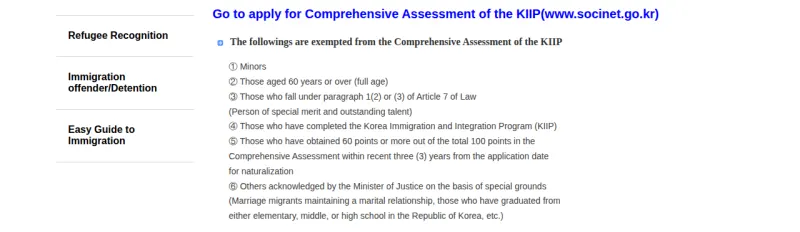
- Minors (exact age cutoff not specified on HiKorea’s page for this exemption specifically, so confirm with your nationality office)
- Applicants aged 60 or older
- Anyone who has completed Social Integration Program (KIIP) coursework
Don’t assume you’re exempt without confirming
Age and KIIP-completion exemptions are based on official records, but how your nationality office verifies and applies each one isn’t published. Confirm your status with them directly rather than skipping evaluation prep and assuming you’re covered.
Need Help With Your Naturalization Application?
If you’re still sorting out your residency status before naturalization becomes relevant, our guides to reporting a lost Alien Registration Card and Smart Entry Service eligibility cover two other common HiKorea procedures for foreign residents living in Korea long-term. And if you’re researching naturalization before you’ve even entered the country on the right visa, our Korea entry guide to visas and K-ETA is the right starting point.
Foreigners’ General Information Center 1345
- Phone Number: 1345 (Domestic) / +82-1345 (International)
- Hours: Weekdays 09:00-22:00
- 09:00-18:00: Supported in 20 languages including Korean, English, Chinese, Japanese, Vietnamese, Thai, and Mongolian
- 18:00-22:00: Korean, English, Chinese
Official Resources
FAQ: Naturalization Interview and SIP Evaluation Questions Answered
Since March 1, 2018, the written test was replaced by the Social Integration Program (SIP) Comprehensive Evaluation, which checks Korean language ability and understanding of Korean society on a 100-point scale.
60 points or more out of 100. HiKorea’s page doesn’t list a different threshold for different naturalization categories.
One year from your original naturalization application date, not from whenever you first attempt the evaluation.
Minors, applicants aged 60 or older, and anyone who has already completed Social Integration Program (KIIP) coursework. Confirm the exact process with your nationality office, since HiKorea’s page doesn’t detail how each exemption is applied.
Korean language ability and a general understanding of Korean society. HiKorea doesn’t publish an exact topic breakdown, but the evaluation is designed to align with Social Integration Program (KIIP) coursework.
At one of 19 dedicated nationality service offices, assigned by your residence jurisdiction (joint applicants use the primary applicant’s address).
HiKorea lists General, Simplified, and Special Naturalization as the three main categories, but its page on the evaluation itself doesn’t say whether the requirement or exemptions differ by type. If your application falls under a specific type, confirm with your nationality office whether the same evaluation rules apply to your case.
Still have questions about your naturalization application or the Social Integration Program evaluation? Contact the Foreigners’ General Information Center at 1345 (Weekdays 09:00-22:00).
We hope this guide helps you prepare for your evaluation with a clear sense of what’s ahead. Good luck!



Comments
Leave a comment